2 Knot vs. 4 Knot Stringing Patterns: Which Is Better for Your Frame?
When getting your badminton racket restrung, you may hear your stringer mention 2 knot or 4 knot stringing. Many players wonder which method is better and whether the number of knots can affect racket performance or frame safety.
The answer is not simply that 4 knot is better than 2 knot, or vice versa. The correct stringing pattern depends on the racket manufacturer’s recommended pattern, the racket design, the stringing method, and the stringer’s experience.
If you are looking for racket gutting near me or professional badminton racket stringing in Ahmedabad and Gandhinagar, understanding the difference can help you make a better decision.
What Is 2 Knot Stringing?
In a 2 knot stringing pattern, the main and cross strings are generally completed using two knots.
The stringer uses longer continuous sections of string to complete the mains and crosses, depending on the racket’s recommended stringing pattern.
Advantages of 2 Knot Stringing
2 knot stringing can offer:
- Fewer knots
- A clean finish
- Less string waste
- A commonly used pattern for many rackets
- Efficient string installation
However, a 2 knot pattern should only be used when it is appropriate for the specific racket.
What Is 4 Knot Stringing?
A 4 knot stringing pattern uses separate string sections for the mains and crosses, resulting in four knots.
This gives the stringer greater separation between the main and cross string sections.
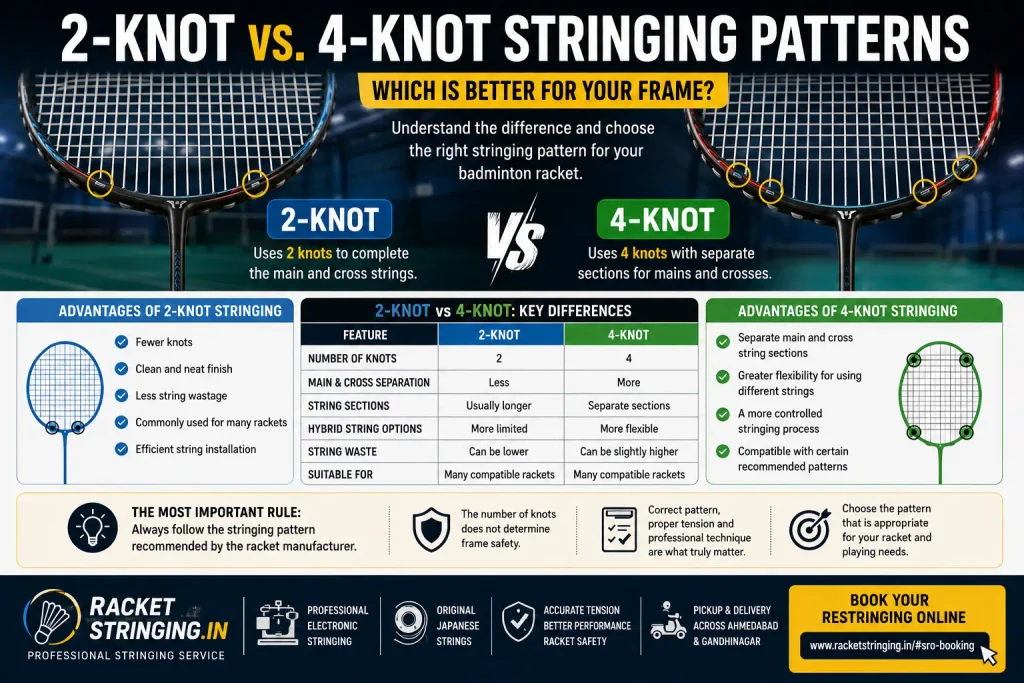
Advantages of 4 Knot Stringing
4 knot stringing can offer:
- Separate main and cross string sections
- Greater flexibility in selecting different main and cross strings
- A controlled stringing process
- Compatibility with certain manufacturer recommended patterns
For players who want different strings in the mains and crosses, 4 knot stringing can be particularly useful.
2 Knot vs 4 Knot: What’s the Difference?
The biggest difference is how the string is divided during the stringing process.
| Feature | 2 Knot | 4 Knot |
|---|---|---|
| Number of knots | 2 | 4 |
| Main and cross separation | Less | More |
| String sections | Usually longer sections | Separate sections |
| Hybrid string options | More limited | More flexible |
| String waste | Can be lower | Can be slightly higher |
| Suitable for | Many compatible rackets | Many compatible rackets |
Neither method is automatically better for every badminton racket.
Which Stringing Pattern Is Better for Your Frame?
The most important rule is simple:
Follow the stringing pattern recommended by the racket manufacturer.
Badminton rackets are designed with specific stringing patterns, grommet layouts, and recommended tension ranges.
Using an unsuitable pattern just because it has fewer knots or is considered more professional is not a good approach.
A professional stringer should check the racket before starting the job and use the appropriate pattern.
Can 2 Knot or 4 Knot Stringing Damage a Racket?
The number of knots itself is not what determines whether your racket will be damaged.
Frame safety depends on several factors, including:
- Correct stringing pattern
- Recommended tension range
- Proper racket mounting
- Accurate tension
- Even tension distribution
- Correct clamping
- Condition of the grommets
- Stringer’s technique
This is why professional racket gutting is more than simply putting new strings into the racket.
Does 4 Knot Stringing Give More Power?
Not necessarily.
Power is affected by several factors, including:
- String type
- String tension
- Racket characteristics
- Player technique
- Shuttle type
- String condition
The number of knots alone does not automatically make a racket more powerful.
If you are trying to improve power or control, choosing an appropriate string and tension is generally more important than simply choosing between 2 knot and 4 knot.
You can learn more in our guide on Why String Tension Affects Your Badminton Performance:
https://www.racketstringing.in/blog/why-string-tension-affects-your-badminton-performance/
Can 4 Knot Stringing Be Better for Hybrid Strings?
Yes.
If you want to use one type of string for the mains and another type for the crosses, a 4 knot setup is commonly used because the main and cross strings are installed as separate sections.
For example, a player may want to combine different string characteristics to achieve a preferred balance of feel, repulsion, control, and durability.
However, the setup should still be appropriate for the racket and string combination.
Why Stringer Experience Matters
A professional stringing machine can provide accurate tension, but the machine is only one part of the process.
The stringer also needs to understand:
- The racket’s stringing pattern
- Main and cross string sequence
- Tension requirements
- Proper clamping
- Knot placement
- Grommet condition
- Frame support
This is particularly important when working with high tensions or expensive badminton rackets.
You can learn more about our equipment in Why We Use a Professional Yonex Electronic Stringing Machine for Every Badminton Racket:
https://www.racketstringing.in/blog/professional-yonex-stringing-machine/
What About Racket Gutting?
In Ahmedabad and Gandhinagar, many badminton players use the term racket gutting when referring to badminton racket stringing or restringing.
Whether you choose 2 knot or 4 knot stringing, the important thing is that the racket is restrung according to the correct pattern and tension.
If your strings are worn, loose, or broken, professional racket gutting can restore the feel and performance of your racket.
2 Knot or 4 Knot: Which Should You Choose?
For most players, there is no need to choose a knot pattern based purely on preference.
Instead, ask your stringer to check your racket manufacturer’s recommended stringing pattern.
Choose 2 Knot When:
- Your racket supports the pattern
- You want a conventional 2 knot setup
- You are using one string throughout the racket
- Your stringer confirms that the pattern is suitable
Choose 4 Knot When:
- Your racket supports the pattern
- You want separate main and cross strings
- You are using a hybrid setup
- The manufacturer or experienced stringer recommends it
The right pattern is the one that is appropriate for your particular racket, not simply the one with more or fewer knots.
Looking for Professional Racket Gutting in Ahmedabad & Gandhinagar?
At RacketStringing.in, we provide professional badminton racket stringing and racket gutting for players in Ahmedabad and Gandhinagar.
Our service includes:
- Professional electronic stringing
- Accurate string tension
- Original Japanese badminton strings
- Careful racket handling
- Pickup and delivery
- Convenient online booking
If you are unsure whether your racket should use a 2 knot or 4 knot pattern, the safest approach is to check the racket’s recommended stringing instructions before restringing.
You can learn more about How It Works here:
https://www.racketstringing.in/#sro-how
Ready for your next racket gutting?
Book Restringing:
https://www.racketstringing.in/#sro-booking
Frequently Asked Questions
Is 2 knot or 4 knot better for badminton rackets?
Neither is universally better. The correct pattern depends on the racket manufacturer’s recommended stringing pattern and the player’s requirements.
Is 4 knot stringing safer for the racket?
Not automatically. Frame safety depends on using the correct pattern, appropriate tension, proper mounting, and professional stringing technique.
Can I use different strings for mains and crosses?
Yes, a 4 knot setup is commonly used when installing different main and cross strings, provided the racket and string setup are suitable.
Does 2 knot stringing save string?
It can use less string in some setups, but the exact amount depends on the racket, stringing pattern, and stringer.
Should I ask for 2 knot or 4 knot stringing?
Rather than choosing based only on the number of knots, ask your stringer to follow the manufacturer’s recommended pattern for your specific racket.
Final Thoughts
2 knot and 4 knot stringing both have their place in badminton racket stringing.
The most important consideration is not the number of knots but whether the correct stringing pattern, tension, equipment, and technique are being used for your racket.
For expensive or high tension badminton rackets, professional stringing is especially important. A correctly strung racket can provide a more consistent playing feel while helping protect your equipment.
If you are looking for racket gutting near me in Ahmedabad or Gandhinagar, choose a service that understands your racket rather than simply choosing a particular knot pattern.
Free pickup & delivery anywhere in Ahmedabad. 24-hour turnaround.
🏸 Book Restringing Now